At Crim our well-being strategies, rooted in mindfulness, are driven by dedicated staff who focus on promoting emotional regulation, trauma-informed practices, neuroplasticity, mindful movement, and other topics that support sustained mental well-being.
We believe in making mindfulness - the practice of bringing kind, non-judgmental awareness to the present moment - an accessible, everyday tool for everyone, delivered through trauma-informed practices and techniques.
Our ultimate goal is to cultivate a community culture of mental well-being where:
- Institutions (schools, workplaces, justice systems) are places of connection, care, and responsiveness.
- Individuals have the mindfulness skills to navigate life with compassion for themselves and others.

The Science of Mindfulness
Our well-being initiatives are rooted in mindfulness and backed by neuroscience - the science of the brain. We know that chronic stress and adversity, like Adverse Childhood Experiences, can keep the brain's alarm system (the amygdala) on high alert. This creates a state of toxic stress that can harm focus and emotional control.
Research has shown that mindfulness principles, practices, and techniques can significantly reduce or reverse the impact of toxic stress.
Mindfulness achieves this by:
- Building New Neural Pathways: Regular mindfulness strengthens the prefrontal cortex - the brain's center for rational thought and decision-making.
- Reducing Reactivity: Mindfulness can reduce hyperactivity of the amygdala, allowing individuals to develop the critical skill of pausing to reflect before responding, moving from impulsive reaction to intentional, mindful choice.
Our Strategy: Driving Culture Change
The Crim strategically implements programs and events using trauma-informed and evidence-based approaches to address the impact of toxic stress and build cognitive flexibility across numerous community sectors. We ensure the benefits of mindfulness reach all community members, from youth and justice-impacted individuals to frontline professionals and organizational leaders.
FOCUS AREAS:
Providing professional development in trauma-informed practices, emotional regulation, Search Inside Yourself Leadership Institute, and ACEs education to staff across various sectors.
Offering structured and evidence-based programs like Mindfulness-Based Stress Reduction (MBSR), Chair and Mat Yoga, ACEs Education, and Mindfulness in Athletics
Facilitating unique cross-sector initiatives like Courageous Connections, specifically designed for dialogue and relationship building between community members and law enforcement.
Our Work In Action
We've built deep, lasting partnerships throughout Flint and Genesee County, allowing us to offer and nurture mindfulness where it's needed most. The program examples below illustrate how community members are experiencing mindfulness, developing stress management skills, and building relationships with compassion and understanding.
Courageous Connections
Developed in partnership with Brown University and Mindful Badge, Courageous Connections seeks to improve community safety and build healthy relationships. The goals of Courageous Connections are:
- Build Human Connection: Help participants see each other beyond their uniforms or labels to connect on a deeper, human level.
- Create a Safer, Stronger Flint: Grow understanding and trust to nurture a safer and more inclusive community for everyone.
- Sustain Long-Term Change: Cultivate lasting relationships and mutual respect that continue to benefit everyday life long after the program ends.

Mindfulness in Sports:
Present in Every Play
Through a unique blend of the Crim Sports and Mindfulness initiatives, we are embedding mindfulness into the fabric of youth athletics across Flint and Genesee County. Using our specialized 6- and 12-week curricula, we provide elementary students with practical tools to manage their feelings, improve focus, and "get in the zone" during competition.
This holistic approach is about more than the young players on the field; we provide comprehensive training for coaches and resources for parents to help them regulate their own emotions. By fostering emotional intelligence in adults, we ensure our youth compete in a supportive, high-performance environment both on and off the field.
Justice Impacted
Imagine a life where stress is a constant, suffocating pressure, where emotional outbursts are inevitable, and coping mechanisms feel useless. This is the reality for individuals incarcerated at Genesee County Jail. As a partner with the Jail's IGNITE (Inmates Growing Naturally and Intentionally Through Education) program, the Crim steps into this environment to deliver crucial mindfulness, movement, and social-emotional learning skills.
The core of this trauma-sensitive intervention is to provide participants with the inner capacity to manage stress and build reliable coping skills, replacing reactivity with mindful decision making. Upcoming, Crim will be rolling out the Prison Yoga Project, a national program that fosters a holistic approach to rehabilitation that promotes empathy, humanity, and justice for all.
Our Impact: How We Know This is Working
Since 2012, the Crim has been a leader in evidence-based mindfulness and mental well-being interventions throughout the Flint and Genesee County community. We have engaged thousands of youth, adults, educators, social service providers and others since the launch of the initiative. In 2025, the Mindfulness and Mental Wellbeing initiative at the Crim served 2,783 individuals. Here are some snapshots of the impact of this work since it has begun.
Through mindfulness, children learn to regulate their emotions, manage their stress, improve their behavior and increase their focus. When it comes to the classroom, this means improved behavior and focus, leading to increased learning and better grades. Working with researchers from Michigan State University in 2017 and 2018, we explored the direct benefits for students and educators.
74% of 4th-grade students reported that mindfulness helps them focus on classwork.
73% of students said it helps them make better decisions and stay calm when upset.
95% of educators found mindfulness to be a valuable intervention for supporting their students.
In 2020, the Crim launched a pilot mindfulness-based stress reduction course for First Responders in Flint and Genesee County, offering tools for managing occupational stress. Here are some results that we’ve had over the years with the First Responders:
100% would recommend the training to a colleague.
86% found the training helped them stay grounded during challenging situations.
71% said mindfulness could help them make greater contributions to their team and community.
70% said they are better able to respond wisely with clear thinking in the moment, rather defaulting to human stress responses of “fight, flight or freeze”
73% said they are more open to learning from setbacks, an indicator of resilience.
88% found the course beneficial and relevant to their work and personal lives.
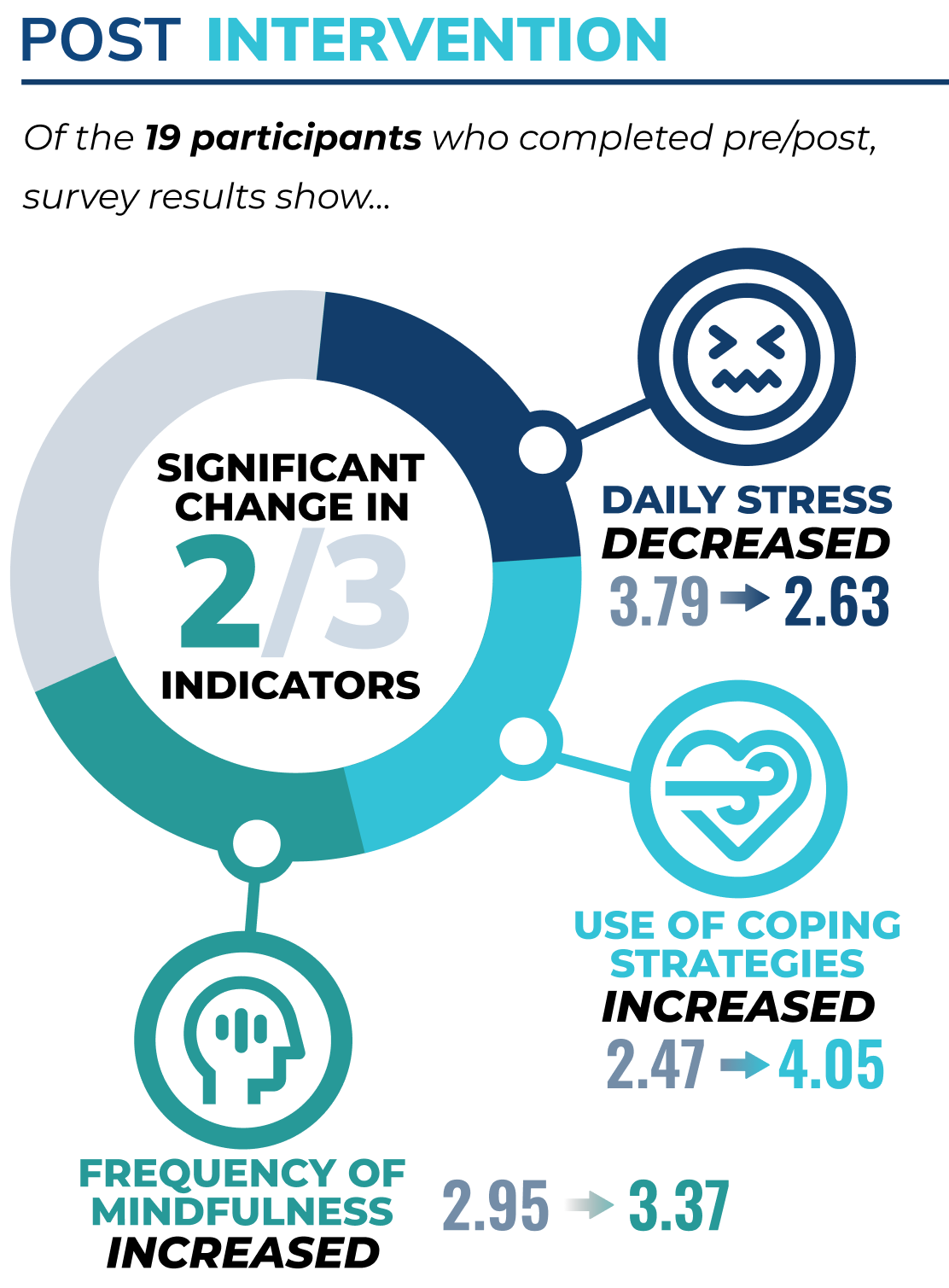
IGNITE participants, residents at Genesee County Jail, have said mindfulness gives them the ability to think before responding and create a safe mental space for themselves while in jail. In 2022, Crim staff began teaching social emotional learning, stress reduction techniques, attention training and mindful movement to jail residents. Here is a snapshot of the impact, from our 2024 program:
Significant Stress Reduction: Participants' feelings of high daily stress dropped by more than a third, with the percentage rating their stress as “moderate to very high” decreasing significantly, from 78% before the program to 50% after.
Mastering Coping Skills: At the end of the program, 100% of participants reported having moderate to very useful coping strategies, an increase from 60% before the intervention.
Mindfulness in Action: The commitment to practice mindfulness grew dramatically, with the use of mindfulness practices increasing from approximately 25% of participants before the program to 99% after.
In 2024, the Crim partnered with Hurley Medical Center to support the professionals who care for our most vulnerable community members. Through this initiative, the Crim facilitated Search Inside Yourself Leadership Institute for 20 pediatric residents. This provided the residents with emotional intelligence and mindfulness tools to help them navigate the stressful environment of pediatric medicine.
93% of pediatric residents reported that the training was relevant to the challenges they faced in their professional roles.
93% of participants stated they would recommend this mindfulness-based leadership training to a colleague.
86% of residents expressed that they were ready to apply the learnings and strategies to both their personal and professional lives.